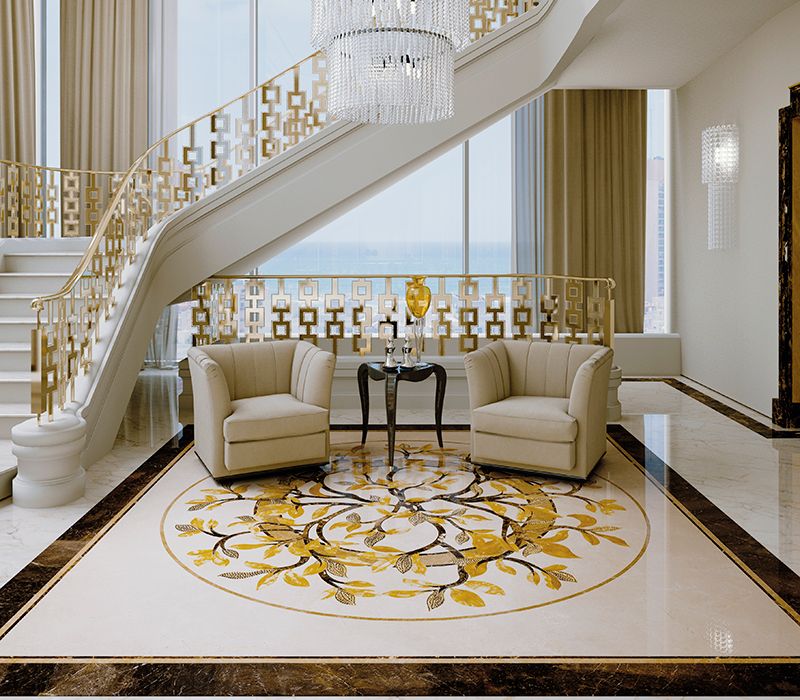
ADVANTAGES OF USING ITALIAN MARBLE IN MODERN ARCHITECTURE:
There is no secret in this that Italian Marble looks classier than other types of Marble and natural stone. This makes it the ultimate fit for your future home improvement project. In this blog, the experts at Bhandari Marble Group have listed some other benefits of choosing Italian Marble or Imported Marble over other stones.
WHAT IS IMPORTED MARBLE?
We will first get down to introducing the meaning of the term ‘Imported Marble’ as it is used in the marble and stone industry. India has deep pockets of natural stone and Indian stone, in fact, being transported all around the world due to its rich mineral compositions and several other advantages and assorted uses. However, Indian stones have a far-flung appeal. For buyers that are looking for something that looks opulent, shiny, and classy, then Italian Marble is what we would suggest. Any stone that is imported to India from other countries is called Imported Marble. This majorly includes Italian Marble as it is a known fact that Italy has some of the best Marble quarries in the world.
PROS OF USING ITALIAN MARBLE IN YOUR SPACES:
• Amplify the look of your interiors- Even though Italian Marble is used for both interior and exterior, our team endorse its extensive use for luxury interiors as Imported Marble performs best in areas with lower footfall. Moderate footfall areas such as interiors- bedroom, bathroom, living room, etc. are great places to be adorned with this type of stone.
• Cleanliness- Other stones, tiles, and even carpets can carry allergens, dust, and stains that do not show easily but such is not the case with Italian Marble. If you are someone who is prone to allergies or there are kids in the house, then it is best to go for Italian marble as its properties make it hypoallergenic and hygienic for your family’s good health.
• Easy Preservation- Once installed, Italian Marble, is going to last you decades without much investment, polishing, or maintenance costs. For cleaning, you can simply run a dust mop on the floor or use a mild detergent to clean stains, or marks, etc.
• Low Porosity- The low porosity of a stone makes it our personal favorite as this means that the stone will not easily absorb and liquids that may spill on its surface which will automatically result in lesser stains. This ensures that the color of the marble stays as it is for decades.
• Durability- Imported Marble is durable enough to take a good weight and is not brittle which means that there would not be any sort of chipping or breakage. Depending upon your choice of stone, Imported Marble can be prone to breakage too, but at the end of the day, it is a natural stone that would still have enough strength to take moderate weights and wear and tear.
• Higher Home Value- The use of Italian marble can increase the price of your home, villa, or building. Marble is like a gem that would make your property more desirable and valuable. What’s better is that marble never goes out of style, especially white Italian Marble. Thus, no matter when you decide to put your property up for sale in the market, nobody would feel that the interiors are cheap or out-dated.
• Versatility- Imported marble can be used in Kitchens, bathrooms, living rooms, bedrooms, and everywhere else throughout your home. In any case, its charm remains the same and we are sure, it would create a ravishing look wherever it is placed.
• So many options to choose from- At Bhandari Marble Group, we provide you with marble from all around the globe. Imported Marble is available in all shapes, sizes, colors, and textures to suit your requirements, choice, and taste. In case you are still looking for something that you couldn’t find, we take custom orders too. There are 5000+ varieties of stone to choose from at Bhandari Marble Group, Kishangarh.
BECOME A DEALER WITH US TODAY! Imported Marble and Granite is in huge demand in India is also shipped abroad from India. It is a booming field that is quite lucrative from a business point of view. If you are looking to become a dealer, it is a good idea to do it under the guidance of an industry pioneer. There are several attractive packages available for you to become a dealer with Bhandari Marble Group. Contact our team today to know more.
NATURAL STONE AT YOUR DOORSTEP: On our website, you can purchase marble from the manufacturer quickly and easily. Before placing an order, please contact our specialists. They will assist you in selecting the finish and color of the stone based on the intended use and the style of the environment.
DOORSTEP DELIVERY: If you are looking to install natural stone in your new home, Contact us at BHANDARI MARBLE GROUP and we would make your task easy and hassle-free. We also offer doorstep delivery where it is ensured that the best quality products reach you.
BHANDARI MARBLE GROUP has been a reliable partner for all your MARBLE GRANITE AND NATURAL STONE requirements since the year 1631. Decades of experience in the marble industry have made us what we are and we remain grateful to you for contributing to our success. BHANDARI MARBLE GROUP has exclusive relationships with some of the world’s most renowned Architects, Interior designers, Builders, Developers from all around the globe. From homes or villas to hotels, we cater to all types of requirements. For more information, follow our Facebook and Instagram.
ADD BY EXPERT AND EXPORT TEAM OF BHANDARI MARBLE GROUP KISHANGARH CONTACT 9829040013
It may surprise you that Italian marble is typically formed out of limestone or dolomite rock, both of which are common types of sedimentary rocks. The rocks are then metamorphosed under heat and pressure when the earth's crust moves, resulting in a recrystallized and hard marble stone. It Depends on the chemical composition of the natural sedimentary rock, and the conditions under which it metamorphoses. When a drop of dilute hydrochloric acid is placed on this rock, it bubbles and fizzes as carbon dioxide is released. This reaction can only occur when a rock is composed of the mineral calcite (CaCO3). When limestone metamorphoses it does not form foliation, but the calcite minerals do grow larger and fuse together, the marble can take a variety of appearances, though nearly always with distinctive wavy veins running through it. Marble can be categorized in a number of ways, and knowing the differences will help you make informed decisions.
Geographic Origin of Italian Marble
The different types of commercial marble sold by retailers are usually named for the region from which they are quarried. Nearly every continent contains deposits of marble, but most of the commercial marble sold for residential building materials comes from Italy, Spain, or other areas of southern Europe. Prior to the marble in Italy was limestone originally millions of years ago. Over time, with the movement of the earth's crust and the formation of these mountains, extreme pressure transformed the limestone into the hard and tough, beautiful marble found there today. The emergence of the marble usually gives clear clues as to its place of origin. Here's a list of the most popular and utilized marbles and where they are quarried.
The Meaning of Marble's Magnesium Carbonate Content
Even though rarely highlighted by marble dealers, different types of marble are sometimes categorized according to the amount of magnesium carbonate they contain. The higher the magnesium carbonate content, the more the marble may react to acids which could etch the marble's surface:
Dolomite marble contains over 40% magnesium carbonate.
Magnesium marble contains between 5% and 40% magnesium.
Calcite marble contains less than 5% magnesium carbonate.
CARRARA MARBLE- BEST ITALIAN MARBLE
The most common Italian marble is Carrara which comes in the best Italian marble list, named for the region it comes from. “Carrara has a gray field, or background,” “with a light gray veining.” This stone can also tend toward blue-gray, and the patterning is usually soft and feathery. One of the lightest colored marbles used for flooring tiles is this which has a classic white or light grey stone with soft gray veins. It is quarried in the city of Carrara in the northern tip of Tuscany, Italy. With hundreds of operating quarries producing this, Carrara marble is one of the most readily available marbles you can choose and select. By some accounts, more than 80% of all marble used in residential construction up to now is Carrara marble. Supplies of Carrara marble are reducing, however, and you can expect other different sources of marble to come into heavier use in the coming years.
CALACATTA MARBLE- BEST ITALIAN MARBLE
Calacatta marble is a white marble with very pronounced veins ranging from gray to golden brown. Originating in the Apuan Mountains in Carrara city, Italy, it is a high-end luxury stone that is used both in countertop slabs and flooring tiles. “Calacatta has a field that’s bright white, and a lot more variation in color than Carrara,” It is available in both honed and polished finishes. Calacatta is quite similar to Carrara marble, but with more pre-eminent veining. Calacatta Marble is a rare and more expensive form of marble.
STATUARY MARBLE- BEST ITALIAN MARBLE
Also called Statuario, this marble is also quarried from the Carrara region of Italy, but it has a lighter field with less color variation than classic Carrara marble. “Statuary also has a brighter white field, but not as much color variation as Calacatta,” The veins are usually a mixture of light and dark gray. Like Calacatta, this is a rare and more expensive form of Italian marble. Statuario marble is the best in the best.
BRECCIA ONICADA MARBLE
Breccia onicada is a warmer, darker marble in creamy browns and reds, and is also quarried in Italy. It is used both for countertops and floors. It is sometimes considered a form of limestone, and the stone has a more complicated veining pattern than most marbles. The term "breccia" refers to the rock's composition, in which broken fragments are cemented together in a fine-grained mixture. This angular, broken pattern makes for a very attractive stone surface.
ARABESCATO OROBICO MARBLE
This is a very dark marble with sweeping veins of light gray to brown. It is a premium, high-end marble that comes from the Brembana Valley in Northern Italy.
EMPERADOR MARBLE
This marble is available in various shades of brown with fine grains and irregular veins. It is quarried from three different regions of Spain. The darker color makes a good choice for high-traffic floor areas and it is also commonly used for fireplace surrounds.
CREMA MARFIL MARBLE
This textured creamy beige stone has an overall yellow, cinnamon, or golden beige color with very soft veins of darker colors. Like breccia onicada, it is sometimes marketed as a form of limestone. It is quarried in Spain.
There are also alluring marbles available from Turkey, Greece, and other regions. These often are quite expensive, but they can have truly unique colors, such as deep reds or greens.
Hiding Acid Etching Stains
It may sound counterintuitive, but the whiter the marble, the less it will show white etching marks resulting from spilled acidic liquids. Etching will also dull spots on polished marbles but fade better into honed finishes.
Surface Finish
Marble tile can be finished with any one of several different surface styles. The most popular marble finishes are polished, honed, tumbled, and brushed.
Polished Marble
One of the prized characteristics of a marble floor is its ability to take a very high polish. This allows the material to be buffed until it glistens in the light and is perfectly smooth to the touch. In lighter-colored marbles, polished tiles will actually glow, with the light of the room penetrating slightly into the stone and then reflecting outward with soft illumination.
There are several drawbacks to polished marble floors. They are very slippery, especially in wet environments. They also easily damage—and will readily show those problems especially in bright light. These blemishes will be more visible in darker solid colored marble materials than they are in the light or single-colored tiles.
Honed Marble
In a honed surface, the marble is grinded down until it is flat and smooth, but not to the point where it is slippery and polished. These tiles allow you to have the beauty of marble but with less concern about slipping hazards.
Honed marble may be more muted and often does not have the same vibrancy of color as a highly polished stone. The finish also still has a relatively low coefficient of friction (which means it's still somewhat slippery), and it can be scratched if not cared for properly.
Tumbled Marble
Tumbled marble is created by processing tiles in a drum with rock and sand aggregate that create small chips, scratches, and rounded edges on the tiles. The resulting tiles have a rustic, natural look. The texture of tumbled marble is ideal for shower floors since the finish reduces the risk of slipping.
Each piece of tumbled marble is slightly different. Though the tiles are fairly standard in size, the shapes will vary slightly, and not every piece will be a perfect right-angled square or consistently textured. This irregularity is part of the appeal of using honed materials.
Brushed Marble
Brushed marble is created by scuffing the surface of the tile with abrasives until a natural antiqued look is created. The brushing process, however, creates a somewhat porous surface that must be frequently sealed in order to resist staining. The floor needs to be cleaned frequently because dust tends to collect in the textured pits of the surface.
Tile Size and Shape
While marble flooring can be installed in large slabs, this is rarely done except informal, commercial settings. For residential use, marble flooring is almost always installed in the form of tiles. Classic marble floor tile is usually square in shape, with several dimensions most common:
Tiles measuring 12-inches by 12-inches and generally 3/8 inch thick are most common.
Tiles measuring 16-inches by 16-inches and usually 7/16 inches thick are also quite common.
Tiles measuring 24-inches by 24-inches and typically 1/2 inch thick are usually the largest available for flooring.
There are also rectangular marble tiles available in a variety of dimensions, such as 8 inches by 20 inches, 12 inches by 18 inches, and 12 inches by 24 inches. There are also geometric tiles, most commonly in the shape of hexagons.
Mosaic Marble Flooring
Marble is often available in a variety of mosaic cuts. These can either be small individual chips or mesh-mounted chips laid on a flexible mesh backing and ready for installation. You can also buy medallions or patterns in which the marble colors are arranged on the mesh mount to create attractive and colorful displays.
Marble Floor Pricing and Installation
Marble tiles can be purchased at big box home improvement centers, but for a wider range of options, consult a specialty flooring store or tile retailer.
Read Labels Carefully
What is sold as marble is sometimes not genuine stone, but rather a "marble-look" porcelain tile that mimics marble and is less costly.
High-End Marble
Marble floor tiles at retail can range in price from as low as $7 per square foot for a pure white Cararra tile to $50 per square foot for a rare tile. You can pay considerably more—prices upwards of $200 per square foot are possible—for designer mosaic tile sheets that feature a blend of marbles in different colors and shapes.
Low-End Marble
Costs for genuine marble at big box home improvement centers can be as low as $4 per square foot to about $20 per square foot, but the selection is generally limited to standard Carrara marbles or other mass-produced varieties.
Marble Floor Installation
As with any tile, you can install marble flooring yourself to save labour costs. In addition to the material costs, professional installation can cost from $3 to about $7 per square foot, depending on the size of the room, the complexity of the work, and the labor cost/availability in your area. Simple square or rectangular tiles will be easier to install, and therefore cheaper, than installations calling for intricate patterns and extensive tile cutting.
With all tile floors, the larger the tile, the fewer grout lines you will have. Grout is one of the most vulnerable parts of a tile floor installation, and the presence of more grout lines will mean that the floor will require more labor to install and more maintenance to keep it protected against stains and water damage. More grout will also present further challenges when removing a marble floor. When practical for the flooring design you seek, choosing large tiles requiring fewer grout lines is the best option.
ADD BY EXPERT AND EXPORT TEAM OF BHANDARI MARBLE GROUP, KISHANGARH, RAJASTHAN, INDIA CONTACT 9829040013
With so many options for shrubbery the perfect garden, some people may question whether the natural stone is worth the extra cost and time to install. Is natural Italian Marble block really the finest option? Can cheaper substitutes do the same job?
We don’t accept they can. In this article, we’re going to explore the perceptible advantages of using Italian Marble for your courtyard.
Why Should I Use Italian Marble Paving for my Courtyard?
Gravel, Pebbles, cement, man-made porcelain, wooden decking… there are dozens of ways you can landscape your garden and make it more substantial. So what makes natural Italian Marble the foremost choice?
1. Italian Marble Block is Incredible
Italian Marble at home outdoors has an authentic, real and natural finish that brings life to a garden. What’s more, it can be styled in so many ways. Stone slabs of different shapes and sizes can be installed for a rustic country feel, or carefully sized and measured tiles can be laid for a modern and moderate finish. Honey, black, grey, cream, tan…. There is no end of options for how you can use natural stone to give your garden a indicate finish.
In addition, each Italian Marble block is completely different. The configuration and colouring of each slab of Italian Marble will be different from the last, creating a truly stunning collage of stone.
2. Italian Marble is Imperishable
It can be absurd disappointing to put time, money, and effort into creating a beautiful garden that doesn’t long-lasting. Everything from weather to child’s play can damage softer materials such as plain grass or wooden decking. However, the Italian Marble isn’t damaged by the weather and even the most over-excited children won’t chip our natural stone block.
Italian Marble is groove-resistant. And, what’s more, making natural stone Italian Marble block a safe and durable Pavement option.
3. The Lifespan or caducity of Italian Marble Outlasts Other Paving Options
Italian Marble will last as long as it is properly maintained. Your paving will be in top condition for years when you choose Italian Marble. And, unlike other patio options which begin to look ragged and smutty over time, natural stone ages beautifully. Marble is naturally weather-resistant, meaning not even heavy rain or strong winds will take their toll.
4. Italian Marble Traps Heat
Everyone wanna enjoy the sun when it comes out – especially in Britain where sunshine is a real treat! The great thing about Italian Marble is that it absorbs heat and slowly releases it. This means when the sun comes out, you can make the most of it. Your garden will feel warmer for longer. Perfect for summers.
5. Italian Marble Block is Low Maintenance
The grass needs to be mowed. Wooden decking needs to be painted. Most patio options take a lot of care.
However, the Italian Marble is the exception. When treated with a proper sealant, Italian Marble becomes resistant to staining. This leaves it easy to clean with simple soap and warm water without the need for heavy scrubbing. But most of the time, a simple brush now and then will do the trick.
This makes Italian Marble a particularly great choice for people who don’t want to spend a lot of time maintaining their garden. Instead, you can simply enjoy the space without worrying about daily cleaning, repair, and maintenance.
Why you should go for Bhandari Marble Group as your Marble Supplier?
As we’ve shown here, Italian Marble makes for an attractive, long-lasting, and fuss-free patio. But why you should go for Bhandari's as your supplier for Italian Marble?
1. Our Italian Marble is Sourced Ethically
Woefully, within our Marble industry, there are many who don’t source their stone ethically.
However, our stone is ethically sourced. All our natural stone is either sourced locally at our quarries or imported from trusted global suppliers.
2. We Follow Environmental- Friendly Practices
We’re all about sustainability at Bhandari Marble Group and adhere to strict laws and environmental policies. We recycle as much waste as possible and cut down on fuel outflow by ensuring the stone block never travels more than 20 miles to its production site. 80% of our baggage is completed by our own fleet, which uses efficient and low-pollution. In addition, we harvest our rainwater and use an on-site water filtration plant that recycles 100% of the water used in production.
ADD BY EXPERT AND EXPORT TEAM OF BHANDARI MARBLE GROUP KISHANGARH, RAJASTHAN, INDIA CONTACT 9829040013